
New Year Home Reset: 12 Ideas for a Fresh Start
January is the one month the house resets itself if you let it. The decorations come down, the guests go home, the calendar clears, and for the first time in weeks the rooms sit still enough to actually see. A new year home reset turns that quiet into momentum: twelve ideas, one per area, that carry the house from holiday aftermath to a fresh start that holds all year.
This is not a deep-cleaning marathon and not a minimalism challenge. It is a room-by-room reset with a specific job in each area: put the holidays away properly, restock what the season consumed, and set up the small systems that keep January calm instead of chaotic. If the holidays left a particular kind of mess behind, our New Year’s Eve Cleanup Plan handles the party aftermath first.
The rule for the whole reset: finish one idea before starting the next. January rewards completed small resets, not half-finished grand ones. Twelve ideas, one weekend each or one per day, your call.
1. Declutter the Decor Before You Store It
Every year, broken ornaments and dead light strings get packed away and rediscovered next December, still broken. Before a single box gets sealed, sort the decorations: working lights in one pile, broken in the trash, ornaments you actually hang in the keep box, the ones that stayed in the box all season in the donate bag.
The stayed-in-the-box test: If a decoration never made it out of the box this year, it does not earn storage space. Donate it now while holiday decor is still in demand at thrift stores. Next December, unpacking a smaller, better box feels like a gift to yourself.
Photograph how the good setups looked before you dismantle them: the mantel arrangement, the tree lighting pattern, the entryway styling. One photo per setup, saved in a “holiday setup” album, makes next year’s decorating twice as fast. Our Christmas Decor Storage Ideas covers the packing side in detail.
2. Take the Tree Down on a Schedule, Not on a Mood

The tree that stays up until mid-January stops being festive and starts being a chore you avoid. Pick a takedown date in the first week of January and treat it like an appointment. Two hours, the whole household, done.
The top-to-bottom order: Ornaments off and boxed first, then lights unwound (not yanked), then the tree out last. Reversing the setup order is the fastest takedown, and boxed ornaments survive the year while bagged ones do not.
Vacuum the tree area twice: once right after the tree leaves, once the next day. Needles hide in carpet and baseboards and reappear for months if you rush this. The second pass is the one that actually finishes the job.
3. Reset the Pantry: Toss the Holiday Leftovers
The holidays leave a pantry full of half-used specialty ingredients: opened cranberry sauce, the weird spice you bought for one recipe, three kinds of sprinkles, stale crackers from the cheese board. January’s pantry reset clears all of it.
The January audit: Pull everything out, check dates, and be honest about what you will actually use. The half-used jar of something expired in November goes. The specialty flour you will use in February stays. A pantry that holds only food you eat is a pantry you can actually cook from.
Restock the five staples the holidays burned through: cooking oil, salt, sugar, flour, and your most-used spice. Starting January with empty staples is how takeout spending quietly doubles.
4. Restock the Cleaning Caddy for the Year
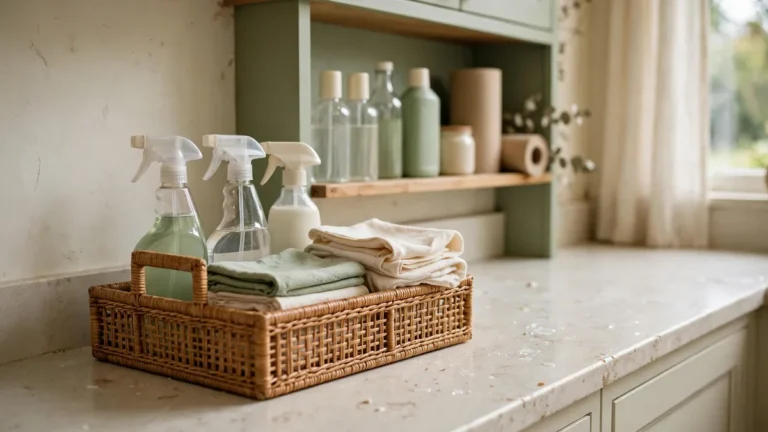
The holidays burn through cleaning supplies faster than any other season: extra paper towels for spills, the good all-purpose spray, dish soap, trash bags. January starts with a caddy audit and a restock, so the year’s cleaning never stalls for lack of supplies.
The one-shopping-trip list: Write down everything that ran out or ran low during the holidays and buy it in one trip. A caddy that starts January full stays full longer, because you are topping up from a full baseline instead of emergency-buying one item at a time.
This is also the moment to replace the worn-out tools: the mop head that smells, the vacuum filter you have been meaning to change, the sponge that should have retired in November. Fresh tools make January cleaning noticeably easier.
5. Wash and Store Every Guest Linen
Guest towels, guest sheets, the holiday tablecloths: all of it gets washed, fully dried, and stored properly in the first week of January, not left in a laundry basket “until later.” Later becomes March, and March’s musty linens get thrown away instead of stored.
The full-dry rule: Linens going into storage must be bone dry. Slightly damp towels sealed in a closet grow mildew within weeks. When in doubt, run the dryer another 20 minutes. Dry is the entire storage strategy.
Store guest linens as complete sets: sheet set, two bath towels, two hand towels, folded together. Next year’s first guest gets a grab-and-go bundle instead of a scavenger hunt through the linen closet.
6. Declutter One Closet Per Weekend
January’s decluttering works best as a slow series, not a single purge weekend. One closet per weekend, four weekends, four closets done: the coat closet, the linen closet, the bedroom closet, the entryway. Small, scheduled, finishable.
The 20-minute sort: Each closet gets a 20-minute sort: keep, donate, trash, relocate. Set a timer. Twenty minutes of honest sorting clears more than two hours of dithering, because the timer forces decisions instead of nostalgia.
Donations leave the house the same weekend. The closet reset does not count as done until the bag is in the car. A donate bag sitting in the hallway for three weeks is just relocated clutter.
7. Start the Year-Round Donation Box

The secret to a house that stays decluttered: a permanent donation box lives in a closet all year. The moment something stops earning its space, it goes in the box. When the box fills, it goes to the donation center. No piles, no decisions twice.
Pick the box’s home now: The donation box needs a permanent spot: the garage corner, the coat closet floor, the laundry room. Somewhere you pass daily, so depositing takes five seconds. A box you have to go find does not get used.
January’s closet declutters (idea 6) seed the box. From there it maintains itself. By December, the box has kept the house lighter all year with zero dedicated decluttering sessions.
8. Reset the Laundry Routine for the New Year
Holiday laundry was survival mode: guest linens on rotation, tablecloths on a 24-hour clock, loads at odd hours. January is when the routine resets to something sustainable: set wash days, a folding station that stays clear, and a hamper system that matches your actual household.
Pick your wash days and post them: Two or three fixed laundry days a week, written on the laundry room wall or the family calendar. Fixed days mean laundry happens before the pile becomes a project. The specific days matter less than the consistency.
Clear the folding surface completely and keep it clear. A folding station buried under clutter means clean laundry lives in baskets, and basket laundry becomes wrinkled laundry becomes re-washed laundry. One clear surface breaks the cycle.
9. Deep Clean the Fridge After the Holidays
The holiday fridge worked hard and it shows: sticky shelves, mystery containers, expired condiments bought for one recipe. The January fridge reset empties everything, wipes every shelf, checks every date, and restocks only what the household actually eats.
The empty-and-wipe method: Take everything out, one shelf at a time, wipe the shelf with warm soapy water, check dates as items go back. The full empty feels drastic and takes 30 minutes; the result is a fridge that looks and smells new. Our Fridge Organization Aesthetic Guide has the bin and layout system to keep it that way.
Toss the holiday-only condiments you will not use again: the specialty mustard, the half jar of something unidentifiable. The fridge should hold January food, not December memories.
10. Paper Reset: Files, Calendars, and the Command Center

January’s paper reset clears the decks: recycle last year’s expired coupons and old mail piles, file the tax documents that arrived, hang the new wall calendar, and reset the family command center with fresh trays and labels.
The calendar handoff: Before recycling the old calendar, transfer every recurring date to the new one: birthdays, anniversaries, annual appointments, subscription renewals. Fifteen minutes now prevents the missed birthday in March.
Set up one inbox tray for the year and commit to processing it weekly. Paper chaos is a flow problem, not a storage problem. One tray in, one weekly processing session, nothing piles up.
11. Restock the Medicine Cabinet and Pantry Staples
Cold season and the post-holiday slump hit in January, and the house should be ready: restock the medicine cabinet with the basics (pain reliever, thermometer, cold medicine), check expiration dates, and make sure the pantry holds real food for real weeks, not party leftovers.
The expiry sweep: Pull everything from the medicine cabinet and check dates. Expired medicine is the most common thing in the average cabinet, and January is the month you actually need it to work. Replace what is expired in one pharmacy trip.
Stock the pantry for ordinary cooking: rice, pasta, canned tomatoes, broth, the oils and spices you use weekly. A January pantry built for real meals makes healthy eating the default instead of the project.
12. Set a 15-Minute Daily Reset for All of January
The reset that protects all eleven ideas: a 15-minute daily reset, same time every day, where the whole household returns things to their homes. Dishes to the kitchen, coats to the hooks, mail to the tray, clutter to the donation box. Fifteen minutes, done.
Anchor it to something: The reset sticks when it is attached to an existing habit: right after dinner, right before the evening show, right after the kids’ bedtime. A floating 15 minutes gets skipped. An anchored one becomes routine by week two.
January’s daily reset is the training month for the whole year. By February it is automatic, and the house that got the fresh start in January keeps it. For the printable version of a rhythm like this, our Cleaning Schedule Printable turns it into a checklist the whole household can follow.
The Reset Wrap-Up
Twelve ideas, one fresh start. Declutter the decor before storing it, take the tree down on schedule, reset the pantry and fridge, restock the caddies, wash and store the guest linens, declutter a closet a weekend, keep a year-round donation box, reset the laundry routine, do the paper reset, and anchor it all with a 15-minute daily reset.
The real win is not a perfect January. It is a house that starts the year lighter, calmer, and easier to live in, with systems small enough to survive February. Reset it now, and the whole year runs on the momentum.