Cleaning List by Room: Step-by-Step Whole-House Guide
Cleaning List by Room: Step-by-Step Whole-House Guide
Here’s the thing: most women don’t need more motivation to clean. They need an order of operations. You walk into the weekend, vacuum the living room first, then scrub the bathroom, then somehow the kitchen counters are dirty again and you can’t figure out why.
That’s not laziness — that’s a system problem. Professionals clean in a specific room order and a specific direction within each room, and it’s the reason they finish a whole house in a couple of hours. No wasted motion, no re-dirtying clean surfaces, no wandering.
This is The Room Order + Top-to-Bottom Method. Two rules, that’s the whole system:
- Room order: Bedrooms → Living areas → Kitchen → Bathrooms LAST. You clean cleanest-to-dirtiest, so the grimiest rooms never contaminate the ones you already finished. (Carry supplies from dirty to clean and you’ll drag bathroom germs through a just-dusted bedroom.)
- Inside every room: Top-to-bottom, left-to-right, dry-before-wet. Dust falls down, so you work down with it. Wet jobs (mopping, wiping) come after dry jobs (dusting, vacuuming) so you’re not dusting a damp floor.
Print this, screenshot it, tape it inside a cabinet door. Here’s the exact list.
Build Your Cleaning Caddy First (5 Minutes)
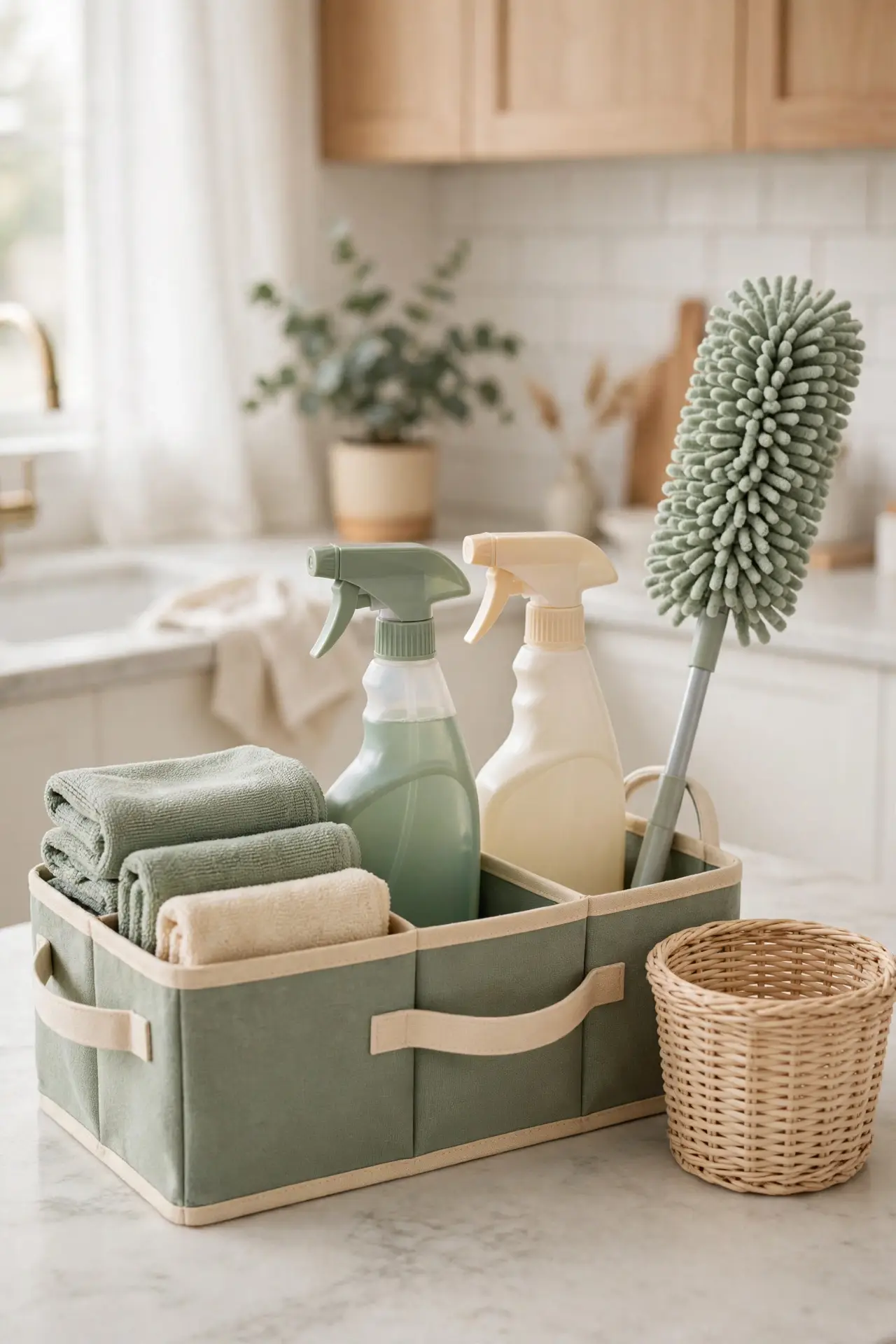
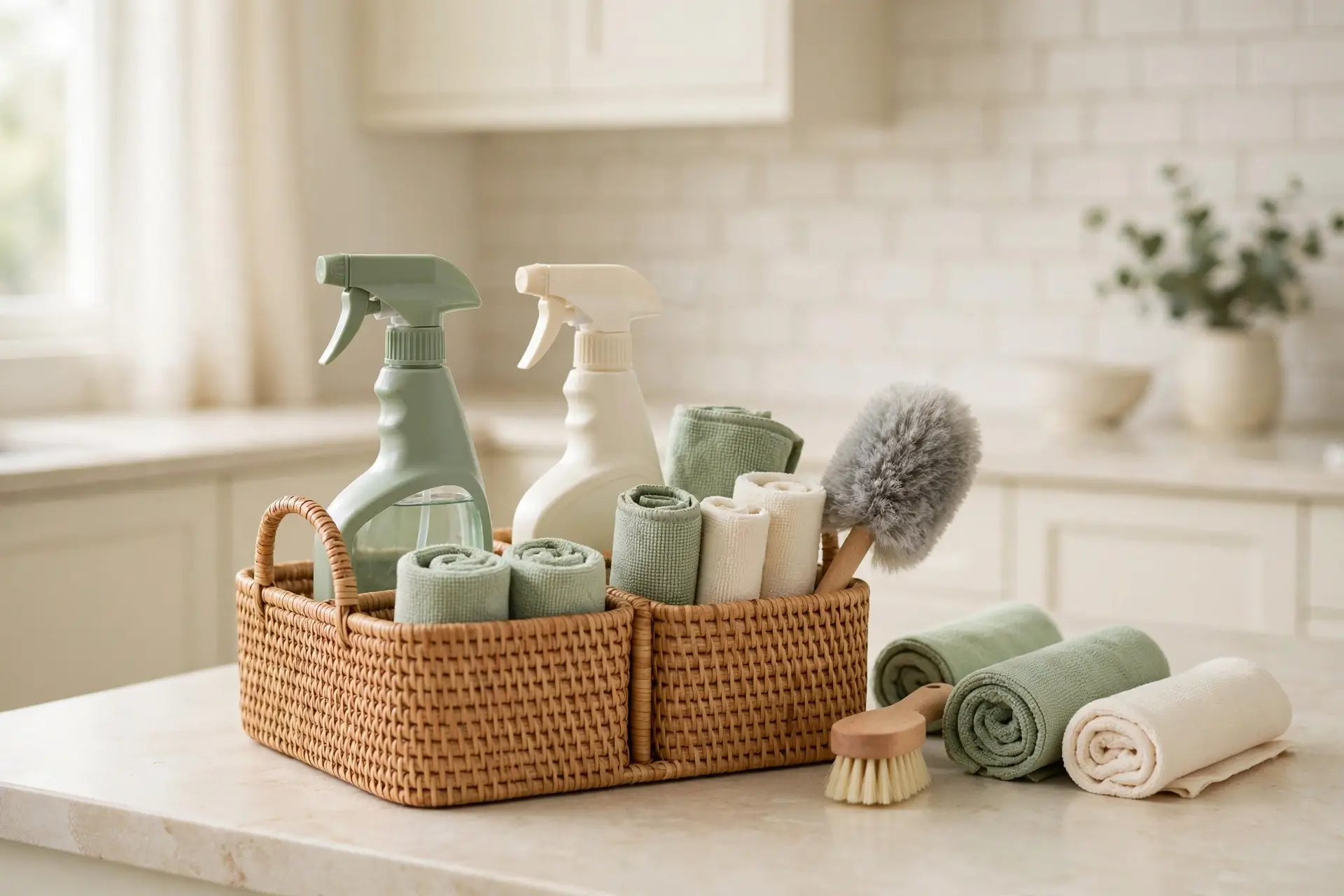
The single biggest time-waster in a whole-house clean is trips: back to the kitchen for the spray, under the sink for the cloths, upstairs for the vacuum attachments. One caddy, carried once, room to room.
Pack it before you start:
- ☐ All-purpose spray (one good one covers most surfaces)
- ☐ Bathroom spray or a dedicated toilet cleaner
- ☐ Glass cleaner for mirrors
- ☐ 3–4 microfiber cloths (one per room zone, then they’re laundry)
- ☐ Dish soap — a drop on a cloth handles greasy spots anywhere
- ☐ Trash bags (2–3)
- ☐ Extendable duster
- ☐ A small “relocate” bin for stray items that live elsewhere
The non-negotiable rule: don’t go back for supplies mid-clean. If something’s missing from the caddy, it doesn’t happen today. Ten trips across the house is how a 2-hour clean becomes 5.
Want to keep the caddy low-tox? Our Non-Toxic Cleaning Swaps for Every Room maps out which harsh products you can replace with simple alternatives, room by room.
Room 1: Bedrooms (Start Here — Cleanest Rooms First)
Bedrooms are mostly dust, sheets, and laundry. Hit them first while your energy is high and your caddy is still clean.
- ☐ Strip the beds — sheets, pillowcases into the laundry pile. Start a load now if the machine’s free.
- ☐ Gather all trash and dirty laundry; drop trash in the caddy bag.
- ☐ Return stray items to their rooms in the relocate bin (don’t deliver yet — one trip at the end).
- ☐ Dust top-to-bottom: ceiling fan blades, tops of frames and the headboard, shelves, nightstands, windowsills, baseboards.
- ☐ Wipe nightstand surfaces and light switches (a quick pass, not a deep clean).
- ☐ Remake the beds with fresh sheets.
- ☐ Vacuum the floor, including under the bed edges and around the nightstands.
Time estimate: 20–25 minutes per bedroom.
Room 2: Living Areas (Living Room, Family Room, Office)
Same order — declutter first, dust second, floors last. Wet jobs don’t exist here, which is why this comes before the kitchen.
- ☐ Gather trash, dishes, and relocate items (same bin as bedrooms — one combined trip at the end).
- ☐ Straighten surfaces: fluff cushions, fold throws, stack remotes, clear coffee tables and side tables.
- ☐ Dust top-to-bottom: ceiling fan or vents, tops of bookshelves and frames, electronics and screens (dry cloth only), windowsills, baseboards.
- ☐ Wipe light switches, door handles, and remote controls — the high-touch spots nobody thinks about.
- ☐ Vacuum upholstery quickly (sofa cushions, pet hair spots) with the brush attachment.
- ☐ Vacuum or sweep hard floors; if mopping, do it now and let it dry while you move on.
Time estimate: 25–35 minutes depending on size.
Room 3: Kitchen (The Middle Job)
By now the caddy has been through bedrooms and living areas — the kitchen is where it gets real. Work in a loop: counters → appliances → sink → floors, always top-to-bottom.
- ☐ Clear everything off the counters — dishes to the sink, clutter to the relocate bin.
- ☐ Wipe cabinet fronts and appliance handles (grease lives here).
- ☐ Clean the microwave: 2-minute steam trick (bowl of water + lemon, run 2 min, wipe clean).
- ☐ Clean the stovetop and oven front; wipe the backsplash.
- ☐ Empty and wipe out the fridge handle, and toss anything visibly expired while you’re there.
- ☐ Scrub the sink: dish soap and a brush, then dry with a cloth so water spots don’t set. Run the garbage disposal with ice + lemon if you have one.
- ☐ Load/start the dishwasher; hand-wash anything remaining.
- ☐ Wipe counters in order: back-to-front, one section at a time, with the all-purpose spray.
- ☐ Sweep, then mop the floor back-to-front — end at the door so you don’t walk on a wet floor.
Time estimate: 35–45 minutes for a full clean.
Note: this is the cleaning list. If your kitchen also needs a declutter pass, that’s a different job — our Kitchen Reset Checklist for the Weekend handles the declutter side separately, so pair them for the full treatment.
Room 4: Bathrooms (Always Last)
Bathrooms are the dirtiest room in the house, so they go last — nothing you touch afterward re-contaminates a clean room. Let the bathroom spray dwell while you work top-to-bottom.
- ☐ Empty the trash and replace the liner.
- ☐ Spray the toilet (bowl, seat, base) with cleaner — let it dwell while you do the next steps.
- ☐ Spray the shower/tub with bathroom cleaner — let it dwell too.
- ☐ Clean the mirror with glass cleaner, top-to-bottom.
- ☐ Wipe counters, faucet, and soap dish; swap the hand towel for a fresh one.
- ☐ Scrub the toilet bowl, wipe the seat and base, flush.
- ☐ Scrub the shower/tub, rinse, and squeegee or wipe the walls.
- ☐ Mop the floor last — around the toilet base, behind the door, corners. End at the door.
Time estimate: 20–30 minutes per bathroom. Two bathrooms = the longest single block of the day.
Room 5: Entryway (The 10-Minute Finishing Pass)
The entryway is first-impression territory, and it re-dirties fastest. Do it last so it stays perfect the longest.
- ☐ Shake out the doormat outside; wipe or sweep under it.
- ☐ Corral shoes — pairs together, off-season pairs to closets.
- ☐ Wipe the entry table or shelf; empty any pockets/junk that collected.
- ☐ Sweep or vacuum the entry floor, then quick-mop if needed.
- ☐ Wipe the front door handle and light switch.
Time estimate: 10 minutes.
The Full-House Time Budget
Add it up: 2 bedrooms (~45 min) + living areas (~30 min) + kitchen (~40 min) + 2 bathrooms (~50 min) + entryway (~10 min) = roughly 3 hours for a full clean, caddy method, no distractions.
Real talk on how to read that number:
- Maintenance clean (you’ve kept the rhythm): 2 hours. Most of the list is a quick pass.
- First-time deep clean: 4–5 hours. Layers of dust take longer than maintenance dust.
- Split it: bedrooms + living areas Saturday morning, kitchen + bathrooms Saturday afternoon. Nobody says it has to be one block.
The timer rule from every other system applies here too: set a timer per room. Open-ended cleaning expands to fill the day; timed rooms keep you moving.
The Rhythm That Keeps It Running (Daily / Weekly / Monthly)
A cleaning list by room only works once. The rhythm is what keeps it working forever — three layers:
Daily (10 minutes, every evening):
- ☐ One load of laundry start-to-finish
- ☐ Dishes in the dishwasher or sink done
- ☐ Counters wiped after dinner
- ☐ 5-minute clutter sweep — relocate bin run
Weekly (the whole-house clean above): One full pass using this room order. The weekly clean is what this list is for.
Monthly (rotate one per month, 30–60 min each):
- ☐ January-style: baseboards, vents, and light fixtures
- ☐ Windows and window tracks
- ☐ Behind/under large furniture and appliances
- ☐ Fridge and freezer full clean-out
- ☐ Cabinets and pantry wipe-down
- ☐ Washer/dryer maintenance (filters, lint, seals)
The weekly whole-house clean plus a Sunday reset is the combo that makes a home feel “always done.” Our Weekly Reset Routine: Sunday Checklist is the companion rhythm — it handles laundry, meal prep, and the week’s setup while this list handles the cleaning execution.
What NOT to Do (The 4 Order Mistakes)
- Don’t clean bathrooms first. You’ll carry toilet-cleaner residue and germs through every clean room after. Bathrooms are last. Always.
- Don’t mop before you dust. Dust falls. If you mop first and dust after, you’ve just re-dirtied a wet floor. Dry work always comes before wet work.
- Don’t clean room-by-room with supplies in another room. If you haven’t built the caddy, you will make 10 trips and lose 40 minutes. Carry everything once.
- Don’t deep-clean and declutter in the same pass. Decluttering is deciding; cleaning is executing. Doing both in one room means you stop every 90 seconds to decide where something lives. Declutter first (different day is fine), then clean.
FAQ
How long should a whole-house clean take?
About 2–3 hours for a typical 3-bedroom home on maintenance rhythm, using the caddy and the room order in this guide. First-time deep cleans run 4–5 hours. If it’s taking longer than that, you’re probably decluttering and cleaning at the same time — split them into separate passes.
Should I clean the bathroom before or after the kitchen?
After — bathrooms go last, always. The rule is cleanest-to-dirtiest: bedrooms, living areas, kitchen, bathrooms. This keeps bathroom germs and cleaning residue from contaminating rooms you’ve already finished.
What’s the best order for mopping?
Mop the floors of each room as the last step within that room, working back-to-front so you end at the doorway and never walk on a wet floor. And mopping is always the last room-level job of the day — right before the entryway finishing pass.
How do I keep up a whole-house clean with kids or pets?
Lower the standard, raise the frequency. Daily 10-minute resets matter more than a perfect weekly deep clean when you’ve got kids or pets — hair and crumbs are daily problems, not weekly ones. Delegate age-appropriate tasks (kids can dust baseboards and run the relocate bin), and vacuum high-traffic areas mid-week instead of waiting for Saturday.