
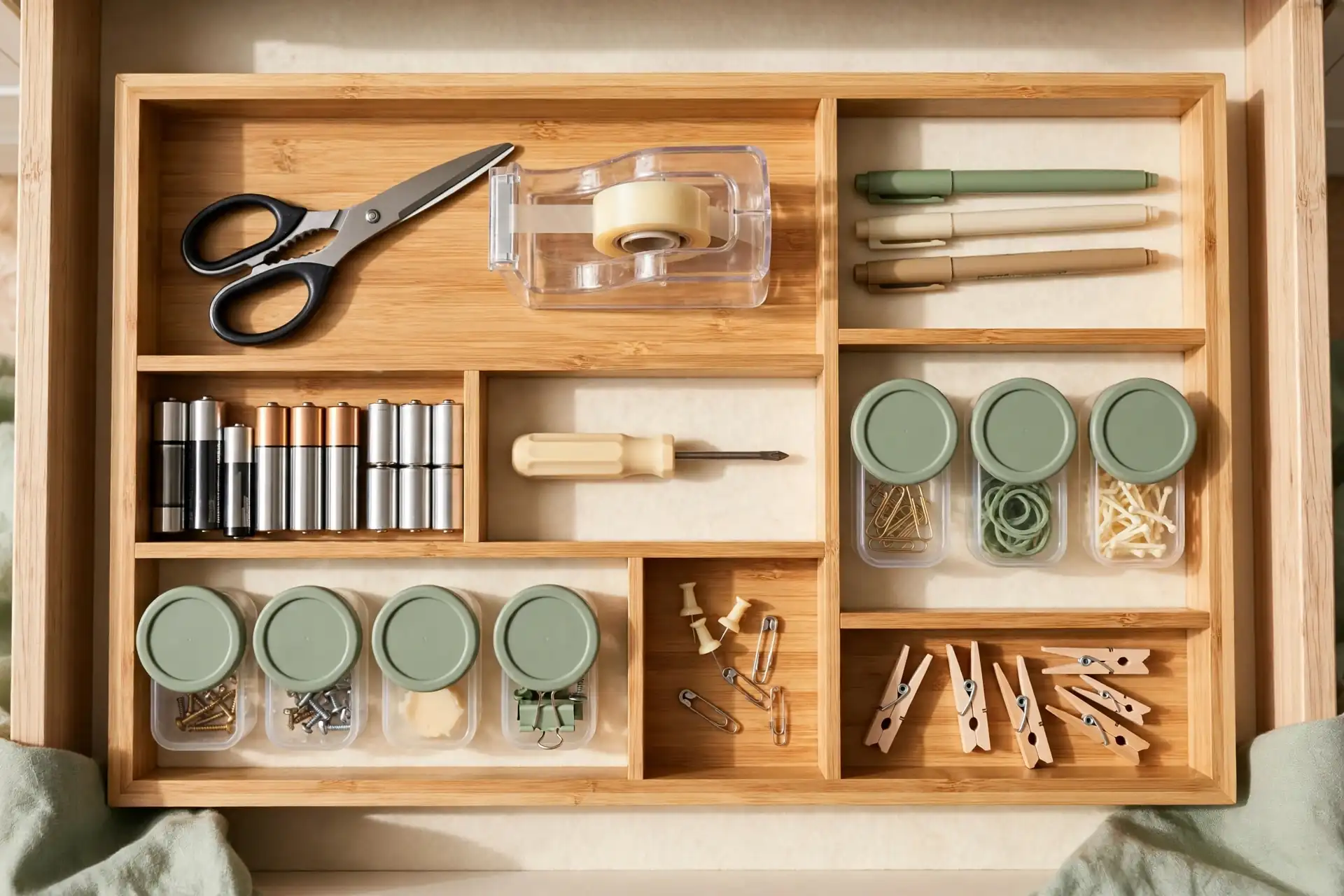
Junk Drawer Organization: 15-Minute Fix
Every home has one. That drawer you open three times a day and close just as fast — batteries rolling into rubber bands, takeout menus from restaurants that closed in 2022, a screwdriver, two mystery keys, and at least one thing you can’t identify at all.
Here’s the thing: the junk drawer isn’t a moral failure. It’s a system failure. It became the junk drawer because it has no rules — everything homeless in your house ended up there. Fifteen minutes and four zones fix that permanently.
Set a timer. Seriously — the timer is the whole trick. A junk drawer feels like a 2-hour project, which is why you keep closing it. It’s a 15-minute project. The timer proves it.
The 15-Minute Method: Dump, Sort, Zone

Do these in order. Don’t skip the dump — sorting inside the drawer is how you end up “organizing” for 40 minutes and changing nothing.
Minutes 0–3: Dump it all out. Pull the drawer out if you can (most lift right out) and dump everything onto the counter or a towel. Wipe the drawer clean — crumbs, dust, the sticky spot. Thirty seconds, fresh start.
Minutes 3–8: Sort into 5 piles. Fast, no overthinking. Touch each item once:
- Trash/recycle — dead batteries, dried-out pens, expired coupons, broken things, takeout menus, rubber bands that lost their snap.
- Relocate — things that live somewhere else (screwdriver → toolbox, tape measure → garage, spare keys → hook). Don’t walk them over now — put them in a “relocate” bag and deliver after.
- Daily tools — the stuff you genuinely grab weekly: scissors, tape, a pen that works, one screwdriver, batteries, a lighter, command strips.
- Fix-it — small repair items: super glue, a few nails/screws, picture-hanging hooks, spare buttons.
- Paper & misc — the notepad, the one takeout menu you actually use, stamps, the tape measure you keep in the kitchen.
Minutes 8–12: Toss the trash pile. Be ruthless here — this is where the magic happens. Dead batteries, pens that don’t write, the 14th rubber band, instruction manuals for things you no longer own, mystery cables to dead devices. If you haven’t used it in a year and it costs under $5 to replace, it goes.
Minutes 12–15: Zone it. Put the keepers back in zones (below) — not tossed in, placed in. Done.
Want a bigger system for the whole house? This 15-minute win is the perfect Day 1 of the 30-Day Declutter Challenge — one small area a day, 30 minutes max.
What to Toss Immediately (No Guilt)
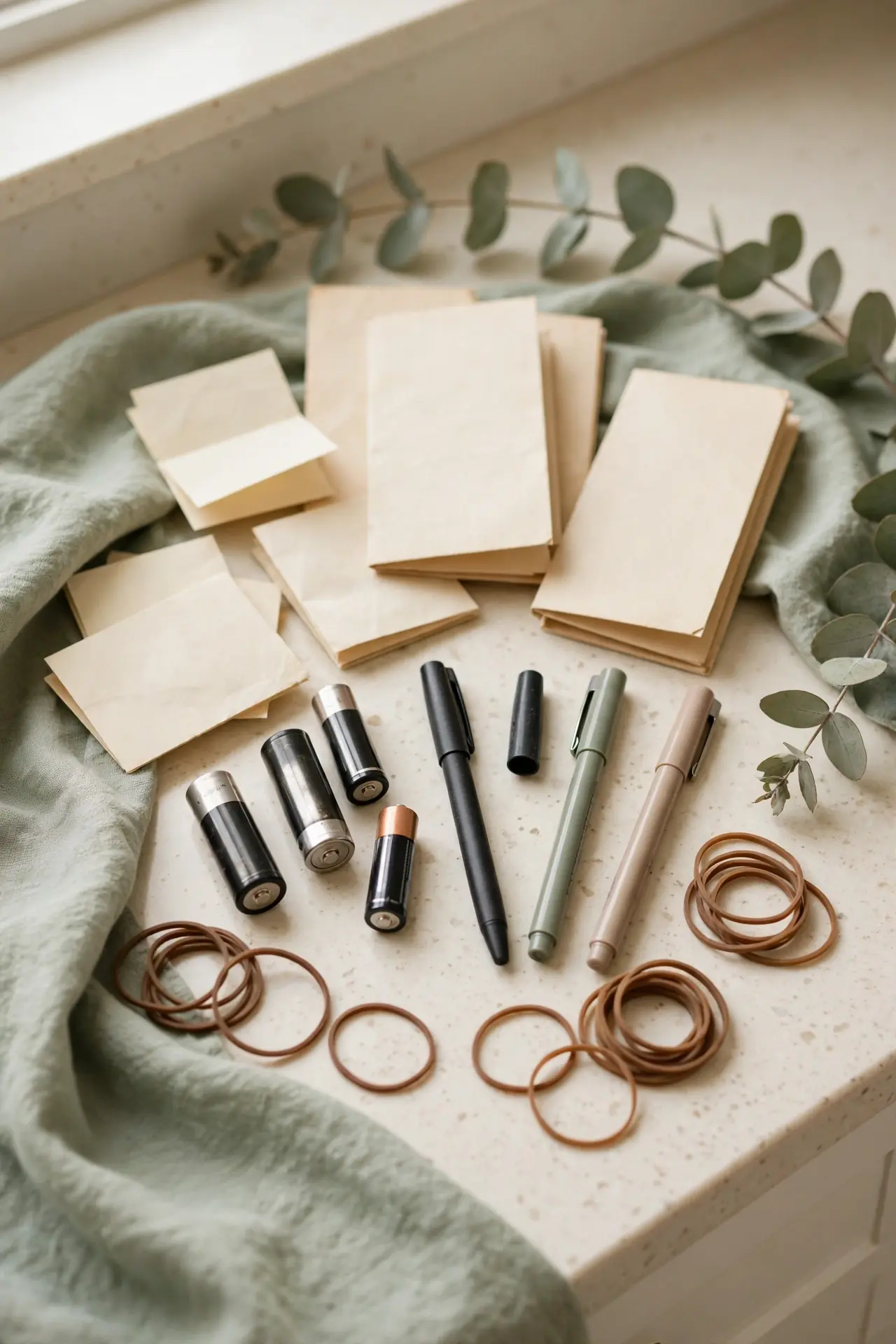
If your drawer looks like most, half of it is trash wearing a disguise. Toss on sight:
- ☐ Dead or corroded batteries (tape the ends, recycle properly — don’t bin lithium batteries loose)
- ☐ Pens that don’t write — test each one, keep max 2 working pens
- ☐ Expired coupons, old receipts, business cards you’ll never call
- ☐ Takeout menus for places you don’t order from (keep ONE if you actually use it)
- ☐ Dried-out rubber bands, broken bag clips, single batteries with no match
- ☐ Instruction manuals for appliances you no longer own (manuals for current ones live online anyway)
- ☐ Mystery keys — if you don’t know what a key opens after a year, it opens nothing you need
- ☐ Promotional junk: branded bottle openers, mini flashlights, chip clips from conferences
The rule that ends the cycle: if it costs under $5 to replace and you haven’t touched it in a year, it doesn’t earn drawer space.
What Actually Earns a Spot (The Keep List)
A working junk drawer — let’s call it the utility drawer from now on — holds only things you grab at least monthly. Cap each category:
- Cutting/sticking: 1 good scissors, 1 tape dispenser or roll, 1 glue stick or super glue
- Writing: 2 working pens, 1 permanent marker, 1 small notepad
- Fix-it: 1 multi-bit screwdriver, a few picture-hanging hooks, 5–6 nails/screws in a tiny container, 1 tape measure
- Power: 4–8 fresh batteries in the sizes you actually use (AA/AAA for most homes), 1 phone charger cable
- Paper: stamps, 1 takeout menu you use, a few envelopes
- Odds that earned it: lighter, box cutter, flashlight, chip clips (max 4), twist ties
That’s roughly 20–25 items. If your drawer holds more than that, something on the list is lying about how often you use it.
Zone It: The 4-Zone Setup
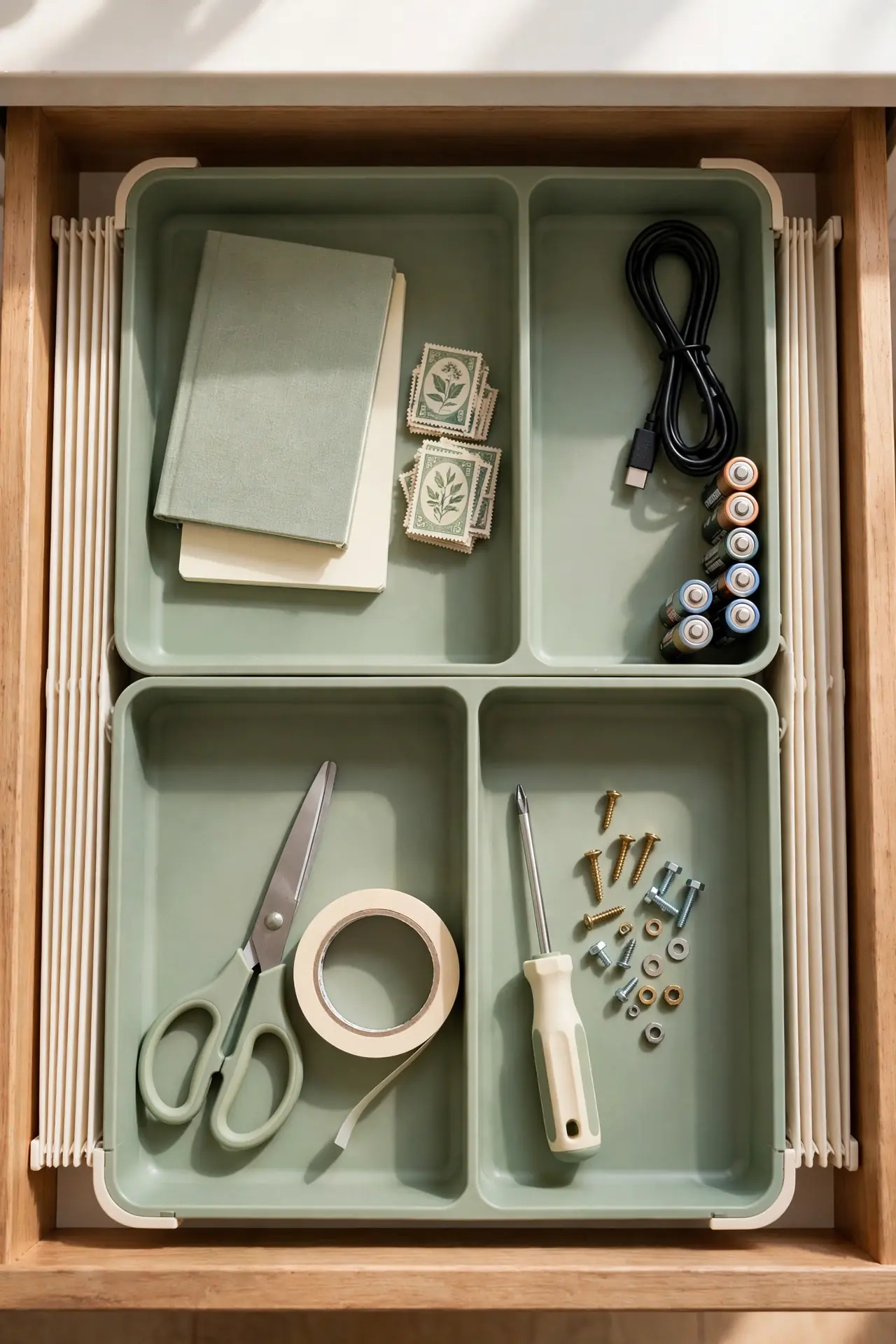
Zones are what separate a utility drawer from a future junk drawer. Assign each zone a corner — front-left, front-right, back-left, back-right — and everything gets a home address:
- Daily grab (front): scissors, tape, pen, notepad. The things your hand reaches for without thinking go closest to you.
- Fix-it (back-left): screwdriver, glue, nails, hooks, tape measure. Repair stuff lives together so you’re not digging.
- Power & tech (back-right): batteries, charger cable, flashlight. Small items that roll — contain them.
- Paper & misc (back): stamps, menu, envelopes, the few things that don’t fit elsewhere.
The zones don’t need labels — after a week your hand just knows. But the zones need walls: a $10 expandable drawer tray or a few small boxes/ramekins keeps zones from migrating into each other. Measure your drawer first (length × width × depth), then buy. The #1 organizer mistake is buying the tray before measuring.
The 30-Second Nightly Rule (Maintenance)
An organized drawer drifts back to junk in about three weeks — unless you give it 30 seconds. When you close the kitchen down at night (part of our Kitchen Reset Checklist routine), open the utility drawer, toss anything homeless into the right zone, and pull out anything that wandered in during the day.
That’s it. Thirty seconds, once a day, and the drawer stays a utility drawer forever. The drift happens because homeless items accumulate one at a time — the nightly rule catches them at one.
Under the sink is the drawer’s bigger cousin — same drift problem, same fix. The Under-Sink Organization guide applies the zone method to that chaos too.
FAQ
How do I keep the junk drawer from getting messy again?
The 30-second nightly rule. Drift is inevitable; the fix is catching it daily before it compounds. Also enforce the one-in-one-out rule: a new item only enters if something leaves.
What organizer is best for a junk drawer?
An expandable bamboo or plastic drawer tray with adjustable dividers — but only after measuring your drawer. For deep drawers, add small boxes or ramekins inside zones to stop small items migrating.
Should every drawer have a junk drawer?
One utility drawer per home is the sweet spot — usually the kitchen. If you have “junk drawers” in three rooms, you don’t have drawers, you have storage avoidance. Give the other two the same 15-minute treatment and retire them.
What do I do with the relocate pile?
Deliver it right after the timer ends — screwdriver to the toolbox, tape measure to its home, spare keys to a hook. The relocate pile sitting on your counter for a week just moves the junk, it doesn’t remove it.